

Why Doesn't My Psychologically Safe Team Perform Any Better?
Because it doesn't activate your team's performance neurobiology. Here's what will.

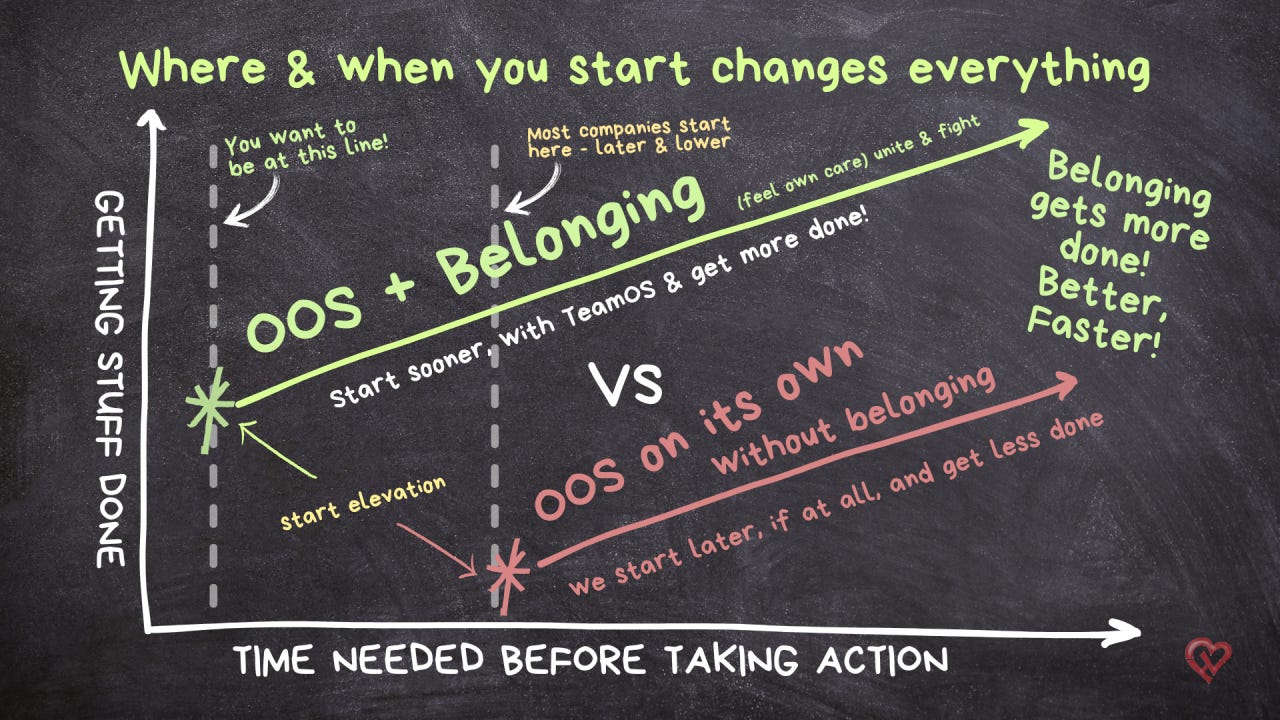
At several of my speaking events, I’ve asked people — by a show of hands — Have you ever stood up for someone at work who suffered at the hands of:
Racism
Negative gender bias
Sexism
Ageism
An all-out hostile work environment
Hands go up every time. Then I ask a sampling of the room: why did you do it? And everybody has a very clear answer.
In four different events, one answer has never come up.
“I did it because I felt psychologically safe.”
Not once.
And yet psychological safety has been the dominant leadership framework for a decade. We’ve built it, measured it, celebrated it. Engagement is still flat. Performance still disappoints. And when people actually do the hard, risky thing — standing up for a colleague who’s being crushed — they don’t reach for psychological safety as the reason.
They reach for something else entirely.
Psychological safety has been a primary leadership focus, and it’s genuinely useful. When Amy Edmondson defined it, she identified a legitimate problem: people perform better when they’re not afraid of punishment for speaking up. And people weren’t speaking up.
But here’s what it’s actually doing neurobiologically. It removes a threat. Cortisol drops. The fight-or-flight response eases. You move from a threat state towards neutral. You get to act — but only because the environment gave you permission (safety).
You are still, fundamentally, in a fear state. The fear is just below the prevent-action threshold.
Lack of negative consequences is still the engine. The condition that drives your inhibition is external: if this space is safe enough, I will contribute.
That’s a transactional model. Safety in exchange for participation. And it has a ceiling. An extremely false one, given human performance potential.
Now think about somebody you would run into a burning building for.
Not metaphorically. Literally. A building on fire. Would you go in?
Most people, if they’re honest, can name someone. Their child. Their partner. Their friend. Their pet.
Their coworker for years, who became something closer than a colleague, is activating that same working circuitry for when you stand up for someone at work.
Ask yourself: you didn’t judge whether or not you’re going to get in trouble or have a negative consequence for running in the house? You did calculate a bit of it. Can I successfully get in and out of the house — but only as a tactical maneuver to achieve the main objective? You didn’t wait (in your mind) for someone to tell you that the environment was safe enough to enter and get out?
No. The choice of action came from a different place. Because something overrode the self-protective calculus, entirely.
This is not about unconditional love. Nor is it reckless abandon. We have a different neurobiological state that oxytocin produces when we have mutual feel-own-care belonging with another person, or pet. Their survival registers in our nervous system as our own. And not as being selfless. You’re acting on a relational condition that has already been met — these people are mine — and once that condition is met, “fear of” gives way to “fear for.
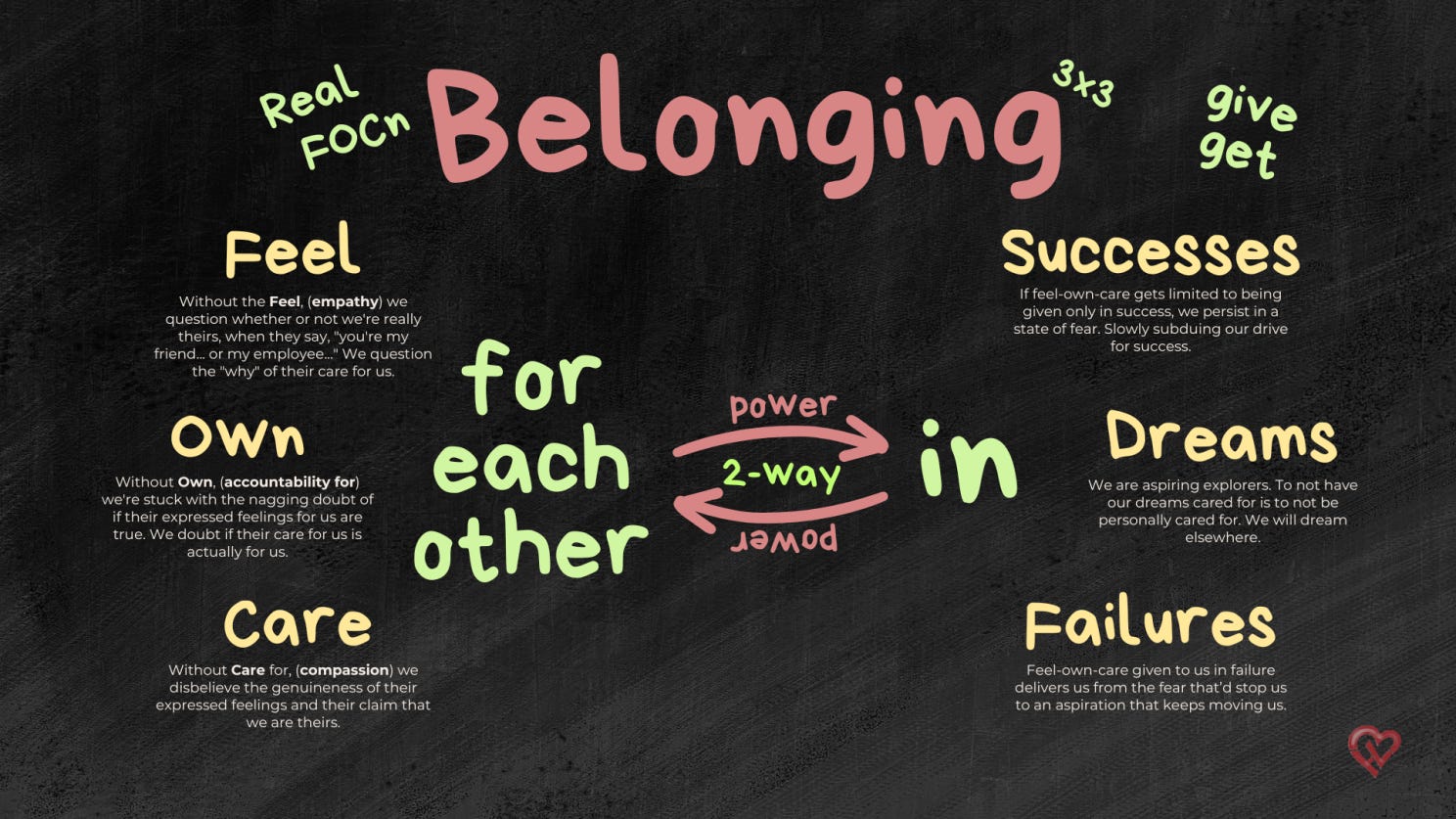
Fear of is self-protective. Fear for is self-risk on their behalf.
Those are not the same thing dressed up in different language. They are categorically different motivational states with different neurobiological mechanisms. Am I safe, inaction, versus drive to secure belonging, action.
This is why framing belonging as “unconditional” is actually sloppy. What happens in deep belonging isn’t that conditions disappear. It’s that the condition shifts entirely. You’re no longer asking, “Is it safe enough for me to act?” You’re asking, “Are these people (and pets) mine?” And once the answer is yes — built through real relationship, through feeling for them, owning the responsibility for their well-being, caring in the form of action for them in their success, dreams, and failures — the calculation of “am I safe enough” doesn’t apply the same way.
Oxytocin doesn’t remove fear; it redirects and lessens it. It binds you to someone else’s safety even at the expense of yours — converting “fear of” into “fear for,” and the impulse to flee into the will to run toward the danger for your people.
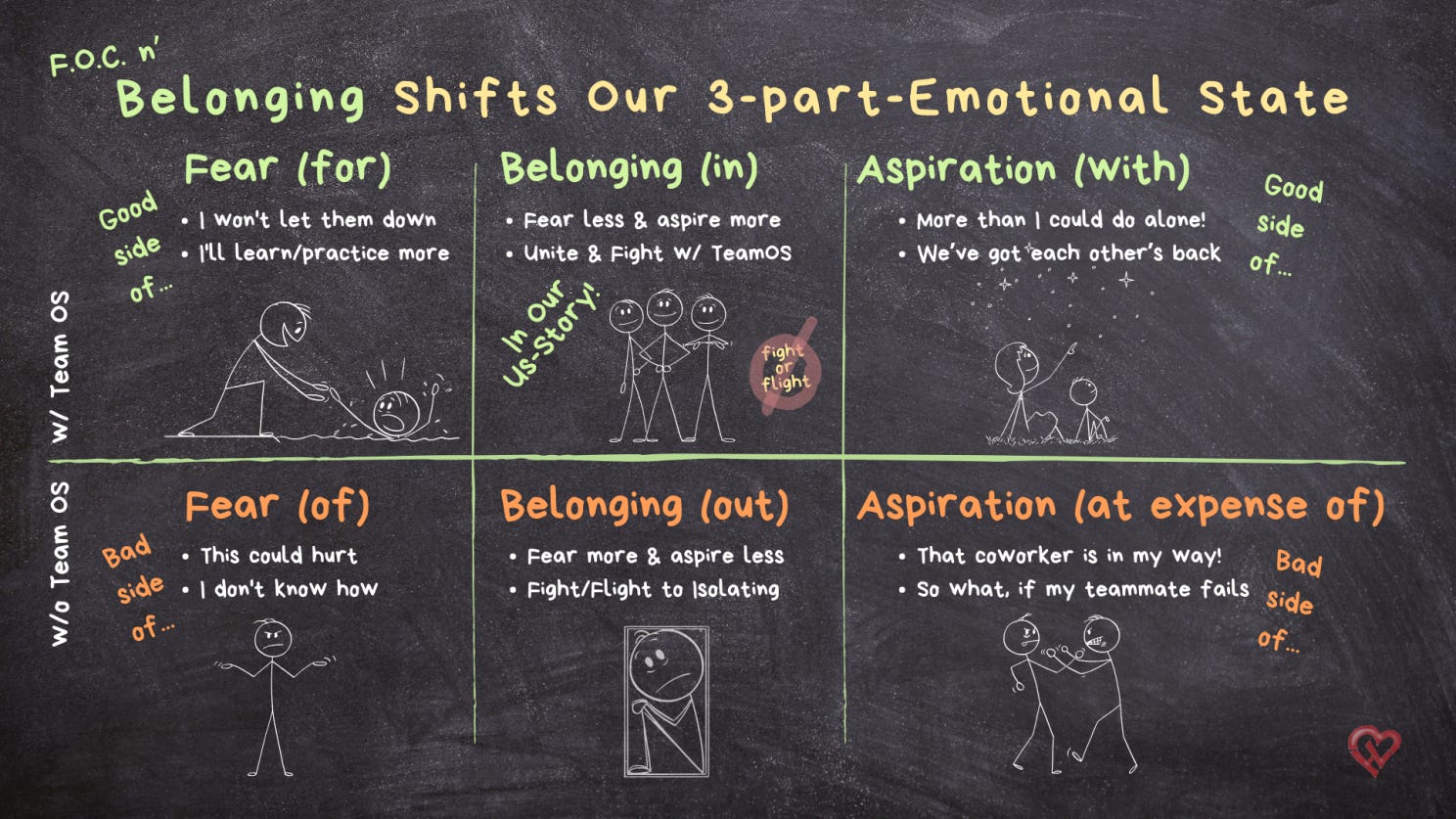
And this is why we also have to dig deeper in our evaluation of one of the most popular definitions of belonging, Cornell University’s. And while it’s well researched, its definition of belonging also misses the mark.
Their framework asks: Do you feel accepted here? Do others include you? It’s a received-mode question. Belonging, in that model, is something that happens to you. By definition, it removes you from your own agency to belong.
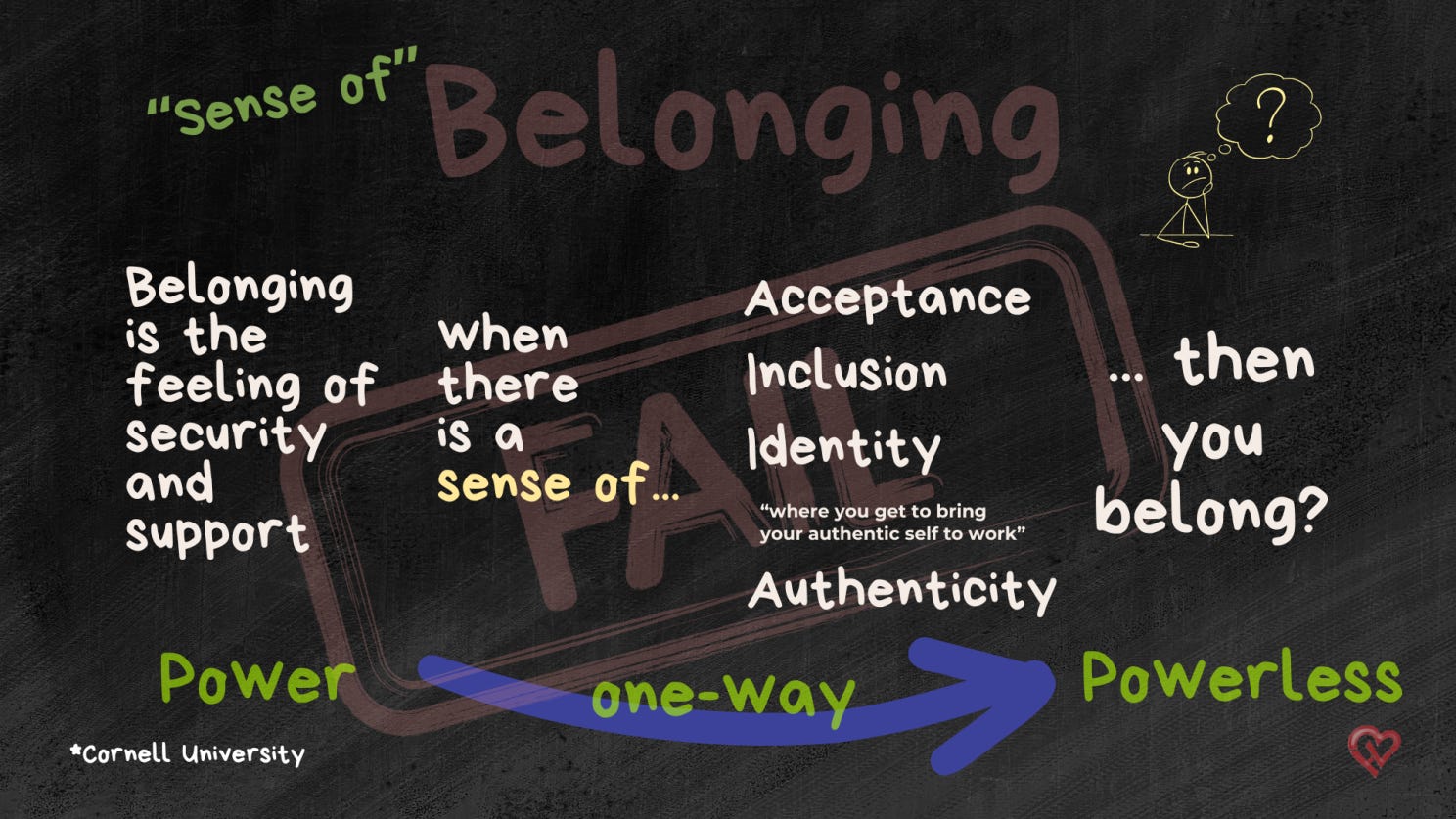
A relational model of belonging unlocks performance — Feel, Own, Care belonging — is bidirectional. You don’t just receive it. You extend it. The question isn’t “Do I feel like I belong here?” The question is, “Do I feel, own, and care for these people?” And in relationship, do they feel, own, and care for me?
They are mine, and I am theirs.
That mutual condition is what produces security in belonging. Not safety. Security. These are not synonyms. Safety is granted by the environment. Security emerges from the relationship itself. And the fact is, in the long run, we’ll move into the space that’s the opposite of safe. We run towards the risk and the inconvenience for each other.
So here’s the realization worth thinking about.
The highest-performing teams you’ve ever been part of — where were they on this spectrum? Were you careful contributors because the environment was non-punitive? Or were you people who ran toward the problem because you couldn’t imagine leaving each other (and your customers) exposed?
One of those is psychological safety. One of those is belonging.
And only one of them produces the neurobiological state where people push their capabilities to the actual limit — not the limit of what feels safe, but the limit of what they’re capable of — for each other.
The performance gap in most organizations isn’t a skill gap. It isn’t even a safety gap.
It’s a belonging gap. And belonging doesn’t start with what you receive.
Ready to close your performance gap?
Start here: The 5-Day Team OS Activation. A free email guide that walks you through what belonging actually is and how to measure it — so you know exactly what you’re building toward. Get the free guide →
Then measure it: The Belong & Perform Assessment, a prototype belonging assessment. Take a first pass at measuring where your team actually stands right now. Take the assessment →
Go deep: Belong & Perform Six Belonging Agreements to Make Elite Team Performance Inevitable — Before Day One. Get the book →